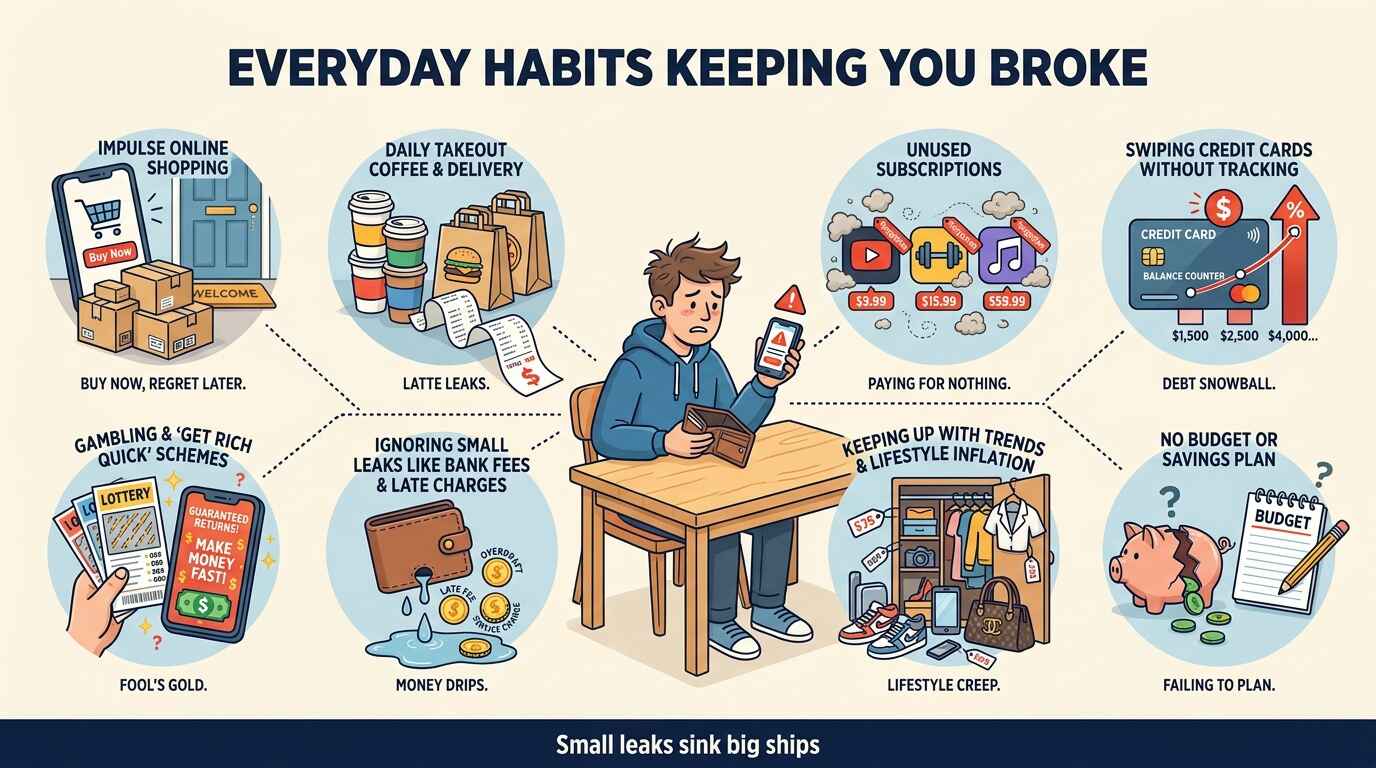
Payday arrives on Friday, yet by Wednesday many bank accounts already look depleted. The cause is rarely an extravagant purchase or irresponsibility. More often, small everyday habits drain finances while appearing entirely normal.
Most people assume financial difficulty comes from one large mistake, such as a bad investment, a lost job, or an emergency. That is rarely the case.
Most people remain financially stuck because of small money habits repeated daily, habits that seem harmless in the moment but erode wealth over years. Many of these habits are socially accepted, and some are even encouraged.
Today we examine the sixteen everyday habits that keep people broke without them realizing it, from impulse spending and lifestyle inflation to subscription traps, emotional spending, and the psychology that causes even intelligent people to struggle financially.
Once the psychology behind money is understood, the question “Why am I always broke?” gives way to a clearer recognition of where the money has actually been going.
My name is Jafel, and I am a wealth building enthusiast. Let’s begin.
16 Everyday Habits That Keep People Broke Without Them Realizing It
The First Habit: Impulse Buying
Companies spend billions studying human psychology, and many late-night online purchases are the result of deliberate design.
Limited-time offers, flash sales, and one-click checkout are all built to interrupt rational thinking and trigger emotional spending. Impulse buying is usually less about the product than about emotion, such as stress, boredom, anxiety, or the desire for a reward.
A study from Slickdeals found that the average American spends over $300 a month on impulse purchases, which is more than $3,000 a year. Invested monthly at an average return of 10% for twenty years, that same amount would grow to over $200,000, so a casual shopping habit could cost six figures.
Impulse spending feels small, with thoughts like “It’s just $25” or “It’s only one thing,” but financial damage rarely looks dramatic at first. It looks convenient.
A practical safeguard is to wait twenty-four hours before buying anything non-essential. If the item is still wanted the next day, it can be bought, though most of the time the desire fades.
The Second Habit: Eating Out Constantly
This does not mean food can never be enjoyed. The problem is unconscious spending disguised as lifestyle. A $15 lunch, an $8 coffee, and a $25 dinner delivery add up to almost $50 a day, roughly $1,500 a month, and $18,000 a year.
That explains why people with decent incomes still feel broke. Food delivery apps sell convenience, comfort, and a small hit of dopamine, so customers are paying to avoid effort rather than for the food itself.
Once the brain grows accustomed to that convenience, cooking feels tedious and meal prepping feels extreme, while the money steadily disappears.
A reasonable starting point is three home-cooked dinners a week, with the aim of building awareness rather than achieving perfection.
The Third Habit: Upgrading Tech Gadgets too Often
Each year, companies persuade millions of people that perfectly working devices are outdated.
A phone still works, a laptop still opens, and a camera still takes good pictures, yet once a newer version is released, people feel behind.
Most of today’s upgrades are emotional rather than functional. The camera is slightly sharper, the screen slightly brighter, and the battery lasts perhaps an hour longer, yet people spend another $1,000 to feel current.
Companies are selling identity, meaning the feeling of being modern, successful, and ahead of others, and social media turns each new gadget into a status symbol presented as a necessity.
Electronics also lose value quickly, and a $1,200 phone can be worth half its price within a year. Wealthy people tend to focus on maximizing value rather than impressing strangers.
Before upgrading, it is worth asking one question: is this purchase solving a real problem, or simply feeding the need to feel updated?
The Fourth Habit: Failing to Negotiate Bills
Many people assume bills are fixed and that the price they are given is simply the price. In practice, companies rely on customer passivity to increase profits.
Internet providers, insurers, phone carriers, and gyms often raise prices gradually because most customers never question them. People also tend to avoid negotiation because they associate it with conflict or awkwardness, so instead of making one uncomfortable phone call, they lose thousands over the years.
If an internet bill is $20 higher than necessary each month, that is $240 a year. Adding insurance overpayments, unnecessary data plans, and miscellaneous service fees can push the loss above $1,000 annually.
A five-minute conversation could fix much of it, and asking costs nothing, even if the answer is no. Financially successful people understand that small recurring savings compound much as investments do.
A useful step this week is to call one provider and ask whether cheaper plans, discounts, or promotions are available for loyal customers. The answer is yes more often than most people expect.
The Fifth Habit Is Paying for Status and Brands
This habit persists because it feels socially rewarding in the moment. Humans naturally want respect, admiration, and validation, which is normal, but companies understand this better than most consumers realize, and brands spend billions building emotional associations around their products.
Clothes, watches, and cars are sold as identity. The luxury car represents success, the designer logo represents importance, and the expensive watch represents power. People then buy things not out of need but to change how others perceive them.
Trying to look wealthy is often the fastest way to stay financially stressed. A person earning $50,000 can easily spend like someone earning $200,000 to maintain appearances, while wealthy people tend to focus less on looking rich and more on quietly building assets.
Real wealth is ownership, not image. Enjoying luxury is not wrong, but it becomes a problem when status spending turns into emotional compensation for insecurity or comparison.
Before buying an expensive branded item, it helps to ask whether the purchase is for one’s own life or for other people’s approval. That one question can save thousands.
The Sixth Habit: Trying To Get Rich Quick
This habit destroys more financial futures than people realize because it targets desperation.
When people feel financially behind, patience becomes painful, saving slowly feels boring, and consistent investing feels too simple, so they start looking for shortcuts. Get-rich-quick schemes are everywhere, including crypto hype, sports betting, forex “coach,” day-trading courses, and promises of overnight success.
Most of these systems sell hope rather than wealth, which is the hope of skipping discipline, bypassing time, and solving years of financial stress with one lucky move. Real wealth is usually built slowly, quietly, and repeatedly.
The stock market has historically rewarded consistency more than excitement, yet people overlook boring systems because human psychology is drawn to dramatic outcomes.
Those chasing fast money often take the biggest risks while understanding the least about money, and that combination is dangerous. Some people do get rich fast, but most observers see only the winners and not the millions who lost money silently.
Building financial stability is a better goal than chasing financial miracles, because sustainable wealth almost always outperforms temporary luck.
The Seventh Habit: Not Caring About the Account Balance
Many people avoid checking their bank account because it makes them uncomfortable. They swipe their card confidently all week but avoid opening the banking app because they are afraid of what they will find.
That avoidance creates larger financial problems, because when people stop paying attention to their money, their money starts controlling them. It is like driving while refusing to look at the fuel gauge because it causes anxiety, and eventually the car breaks down somewhere unexpected.
Many people manage their finances the same way. Financial awareness alone can change spending behavior, and studies consistently show that people who actively track their spending naturally reduce unnecessary purchases, because awareness creates accountability.
Knowing the balance leads the brain to make smarter decisions automatically, so a random online purchase feels different and an unnecessary food delivery becomes easier to question.
Most financial stress comes not from looking at the numbers but from avoiding them for too long.
A sensible practice is to check the account balance every day for thirty days, consciously rather than obsessively, because financial habits cannot improve while a person remains emotionally disconnected from their money.
The Eighth Habit: Paying the Daily Convenience Tax
This habit is dangerous because it feels harmless in the moment. A delivery fee here, a ride-share there, extra for same-day shipping, pre-cut food because it is easier.
Individually, none of these seems significant, but together they form what I call the daily convenience tax, the extra money constantly paid to avoid small amounts of effort.
Convenience is addictive. The more people pay to make life easier, the lower their tolerance for inconvenience becomes. Cooking feels like too much work, walking feels unnecessary, and waiting two days for shipping becomes unbearable.
Companies profit by turning impatience into a business model. Convenience costs more than money, because it also changes mindset, gradually training people to prioritize comfort over long-term financial discipline, and over time that mentality spreads into every area of life.
Convenience itself is not bad, and wealthy people value time too, but there is a difference between using convenience strategically and using it automatically.
A useful exercise is to track every extra fee paid purely for convenience for one week, including delivery charges, express fees, and ride-shares. The total will probably be surprising.
The Ninth Habit: Paying Only Credit Card Minimums
This is among the most dangerous financial habits because it creates the illusion of progress while keeping people trapped.
Credit card companies favor minimum payments because they keep people in debt for years. The balance falls so slowly that most people do not notice how much interest is draining their future.
Consider a $5,000 balance on a card with a 22% interest rate, paid down with only the minimum each month. The interest alone could amount to thousands of dollars before the debt is finally cleared. Debt is also psychological.
Carrying it creates constant background stress that affects sleep, confidence, decision-making, and even relationships, and financial pressure gradually becomes mental pressure.
When income is constantly paying for yesterday’s spending, building future wealth becomes almost impossible, and money keeps traveling backward instead of forward.
Emergencies happen, and minimum payments are sometimes necessary temporarily, but they should never become a lifestyle. The priority should be paying down high-interest debt first, because every dollar of interest eliminated is money permanently reclaimed for the future.
The Tenth Habit: Neglecting Subscription Fees
Subscriptions are designed to feel invisible. Ten dollars for streaming, fifteen for music, another app subscription, cloud storage, premium memberships, and gym plans that are barely used.
Individually they do not seem expensive, which is exactly why they work so well. Companies make subscriptions feel painless because recurring payments reduce the psychological discomfort of spending, and once a payment becomes automatic, the brain stops treating it as an active financial decision.
These small charges quietly multiply. People may notice only one or two subscriptions, but when they review their bank statements, they often find they are spending hundreds of dollars every month on services they barely use or have forgotten.
Subscriptions create a passive spending lifestyle in which money leaves the account silently while the person stays emotionally detached from the loss. That matters because financial freedom usually requires intentional spending, not invisible spending.
Subscriptions are not inherently bad, and some genuinely improve productivity, entertainment, or health, but the problem begins when convenience replaces awareness. A practical step is to go through the bank statement line by line and cancel anything unused in the last thirty days.
Even saving $50 a month equals $600 a year, and invested consistently, that amount compounds far more than people realize.
The Eleventh Habit Is the Buy Now, Pay Later Trap
“Four easy payments” sounds harmless and even comfortable, which is why buy now, pay later systems have grown so popular.
They make expensive purchases feel emotionally smaller. Instead of paying $400 today, the brain focuses on the first $100 payment, the real cost becomes psychologically blurred, and buying things that cannot be fully afforded begins to feel normal.
Buy now, pay later does not remove financial pressure. It delays it. Humans are naturally poor at weighing future consequences and tend to prioritize immediate pleasure over future discomfort, which is why these systems work so well.
Once people grow used to splitting payments, they gradually lose the habit of saving before buying, and debt becomes the default solution for everyday wants rather than for emergencies or necessities.
Eventually, multiple payment plans stack on top of each other, one for shoes, another for electronics, another for clothes, until future income is promised away before it is earned.
Some argue that the plans are interest-free, but that does not make overspending harmless. Before using buy now, pay later, it is worth asking whether the item would still be bought today if the payment option did not exist.
The answer shows whether the item is truly wanted or whether the appeal is simply easier access to it.
The Twelfth Habit Is Financing Items That Cannot Be Afforded
One of the biggest financial traps today is that people no longer buy based on price but on monthly payments. When someone says, “It’s only $300 a month,” attention shifts away from the total cost.
That is how people end up financing cars, furniture, phones, and luxury items they cannot realistically afford over the long term. Monthly payments create an illusion of affordability while quietly increasing financial pressure.
A car may seem manageable at $700 a month, but once insurance, fuel, maintenance, interest, and depreciation are added, the true cost is much larger than expected.
Financing an expensive lifestyle often traps people in a cycle where future income is committed before it arrives, and each paycheck comes already assigned to debt.
That removes flexibility, and emergencies feel overwhelming because no financial breathing room remains. Financing is not always bad, and businesses use debt strategically all the time, but there is a large difference between using debt to build assets and using it to impress people.
Before financing anything, the better question is not whether the payment is affordable but whether the full financial responsibility can be carried comfortably without straining the future.
The Thirteenth Habit: Changing Lifestyle Too Quickly as Income Rises
This is one of the biggest reasons people stay financially stuck no matter how much more they earn.
After a raise, many people immediately upgrade, with a better apartment, a nicer car, more expensive restaurants, luxury vacations, and higher monthly expenses. Income rises, but financial stress often stays exactly the same.
This is called lifestyle inflation. The more a lifestyle expands, the harder financial security becomes, because once the brain adapts to a higher standard of living, the new level quickly feels normal, and what once felt luxurious becomes expected.
Many people believe earning more automatically creates wealth, but wealth is not built by income alone. It is built by the gap between what is earned and what is kept, and that gap is everything.
Humans also tend to adjust spending to match identity, so when someone feels pressure to look successful, expenses rise endlessly to maintain that image.
Enjoying money is not wrong, and the goal is not to live miserably. The problem is upgrading a lifestyle faster than assets grow. One effective approach is to save or invest at least 50% of every raise automatically, before changing anything about lifestyle. That single habit can transform a financial future.
The Fourteenth Habit: Spending Every Dollar Earned
Many people believe they will start saving once they earn more. The uncomfortable reality is that anyone who spends everything they make now will probably spend everything they make later, only at a higher income level.
The real issue is usually not income alone but behavior.
Spending naturally expands to fill the money available, and as soon as extra cash appears, the brain finds new ways to use it, through better clothes, more subscriptions, a bigger lifestyle, and random online purchases, until the paycheck disappears again.
People often think wealth is about earning huge amounts, but financially successful people understand that wealth is built through margin.
The gap between what is earned and what is spent is where freedom actually lives. If every dollar coming in goes straight back out, a person is not building a future but maintaining survival, and that cycle becomes exhausting over time.
Some will say that life is expensive, and that is true, but many people are no longer spending only on necessities. They are spending emotionally, socially, and automatically.
The solution is to set up automatic savings or investment transfers immediately after payday, so that the rule becomes not to save what is left after spending but to spend what is left after saving.
The Fifteenth Habit: Paying Yourself Last
Most people handle money in the same order every month, with rent first, then bills, then shopping, food, entertainment, and other spending, and whatever remains at the end becomes savings. Usually, nothing remains.
Spending expands to consume available money, and if a paycheck sits untouched in an account, the brain treats it as spendable.
That is why saving later almost never works consistently. Wealthy people often reverse the process, paying themselves first through investing, saving, and asset building before lifestyle spending begins.
This also changes identity, as a person stops seeing themselves as barely surviving month to month and starts seeing themselves as intentionally building long-term freedom. Even small amounts matter.
A person who automatically invests just $300 a month over several decades can build substantial wealth, because consistency compounds over time.
Some will say they cannot afford to save right now, but most people can start with less than they think. The moment income arrives, a percentage, even if only 5% or 10%, can be moved automatically into savings or investments first, because building wealth starts with priority, not perfection.
The Sixteenth Habit: Not Learning About Money
This may be the most expensive habit on the list, because ignorance about money compounds just like interest.
Most people were never properly taught how money works. Schools teach algebra, history, and science but rarely cover investing, debt management, taxes, compound interest, or wealth building, so millions of people enter adulthood financially unprepared and spend years learning through painful mistakes.
One good financial decision can be worth hundreds of thousands of dollars over a lifetime.
Understanding investing early, avoiding high-interest debt, learning how assets work, and knowing how to budget properly are skills that quietly shape the direction of an entire future.
People who understand money tend to make better financial decisions repeatedly, while those who avoid learning about it often stay trapped in reactive survival mode.
Money rewards knowledge. Becoming a financial expert overnight is not necessary, and neither are complicated spreadsheets or advanced investing strategies at the start, but refusing to learn because the subject seems boring or confusing is very expensive in the long term.
A workable habit is to spend at least twenty minutes a day learning about personal finance, investing, or wealth psychology by reading books, watching educational videos, and studying financially successful people, because financial freedom often begins with financial awareness.
In summary, most people are not broke because they are unlucky. They are broke because small financial leaks have become normal, and society encourages many of these habits by promoting the message to consume more, upgrade more, borrow more, and look rich.
Actual wealth usually looks boring, patient, disciplined, and quiet. Nothing needs to be fixed overnight, and eliminating even two or three of these habits could change a financial trajectory over the next five years.
Wealth is not usually built through one massive moment but through repeated daily behavior, small choices made consistently for years.
That is how people quietly escape financial stress while others remain trapped in cycles they do not notice. The questions worth asking are which of these habits has been quietly costing the most, and which one to change first.
Sometimes the biggest financial breakthrough is not earning more money but finally understanding where the money has been going all along.