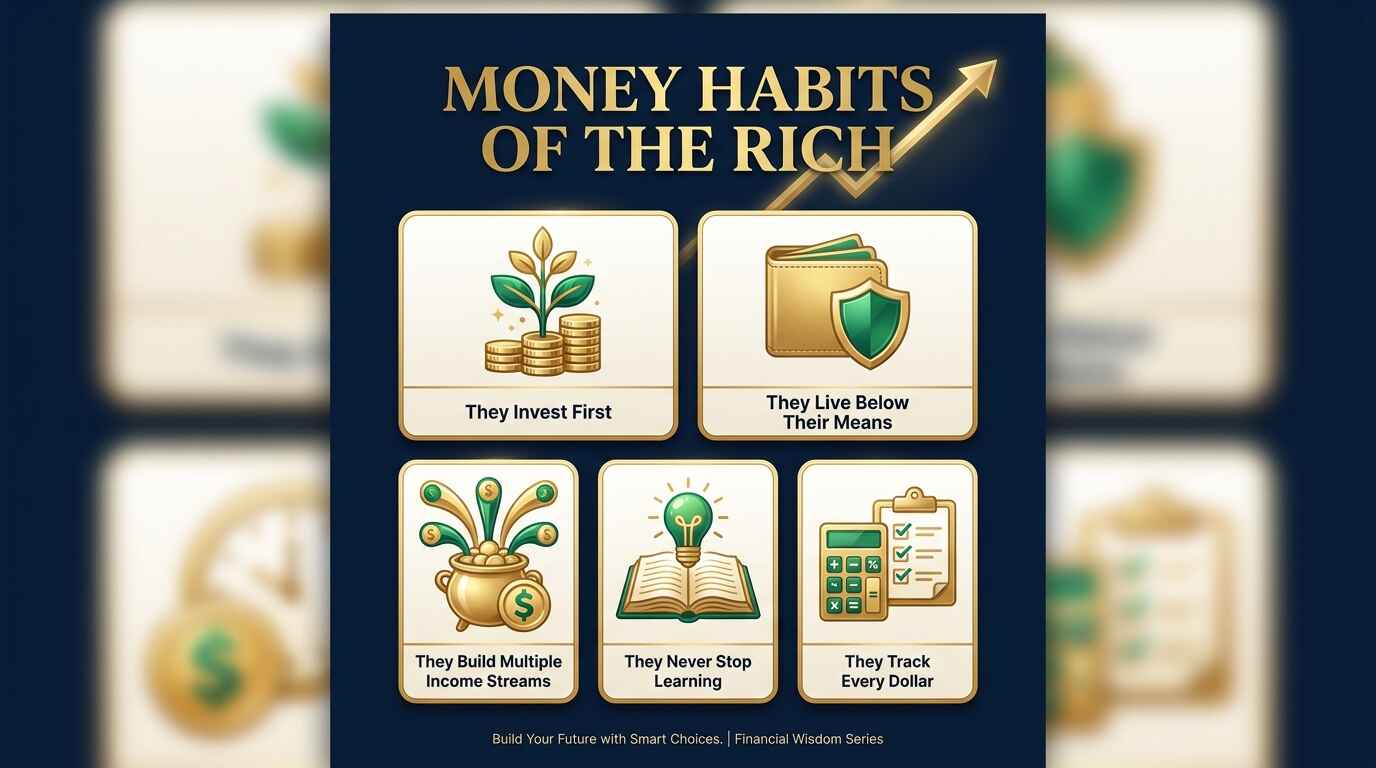
Why do some people build wealth while others continue to struggle? The difference is usually hard to see, and the habits behind it develop quietly and compound over time. This article examines ten money habits that wealthy people tend to share and that others often overlook.
Many people believe that getting rich is a matter of earning more money. The evidence does not support that view. Some professional athletes earned millions and still went broke.
Some lottery winners were left with nothing within a few years of receiving life-changing sums. And some people with average salaries quietly became millionaires.
Wealth is not primarily an income problem. It is a problem of behavior and psychology, and the habits that create it are often the opposite of what society teaches.
Society encourages consumption, while wealth is built on ownership. Society encourages instant gratification, while wealth rewards patience. Society encourages the appearance of being rich, while the wealthy focus on actually becoming rich.
10 Money Habits Rich People Have That Others Don’t
The First Habit: Assets vs. Liabilities.
The wealthy tend not to ask whether they can afford something. They ask whether it will make them richer or poorer. Most people buy things that take money out of their pockets, while the wealthy buy things that put money into them. A liability costs money, and an asset pays money.
Yet many people spend their lives collecting liabilities while believing they are building wealth. A brand-new luxury car loses value the moment it leaves the lot, while an investment that generates cash flow can keep paying for years.
This does not mean wealthy people never enjoy their money. It is a matter of priority: the wealthy typically buy assets first and luxuries later, and most people do the opposite. Consider two people who each receive a $10,000 bonus. One buys a luxury watch.
The other invests the money in an index fund earning an average annual return of 10%, and after 30 years that investment could grow to more than $170,000.
Both decisions felt good at the time, but only one continued to create value decades later. Wealth is built not through giant decisions but through repeated small ones.
The Second Habit: Time Is More Valuable Than Money
People who are not wealthy often spend money to save money, while the wealthy spend money to save time. Most people focus on saving ten dollars, and the wealthy focus on saving ten hours, because money can be replaced and time cannot.
Income is closely tied to how effectively a person uses their time. Someone who spends three hours on a task that could be done by someone else for twenty dollars may save money but lose opportunity. This does not mean everyone should hire assistants and outsource everything.
It means thinking differently about how time is spent. Two hours of social media every day adds up to fourteen hours a week and more than seven hundred hours a year.
Those hours could go toward learning sales, investing, marketing, content creation, or AI tools, and the result could change a person’s income permanently. The wealthy understand that time compounds just like money. Every hour invested today can produce results for years, and every hour wasted is gone for good.
The Third Habit: Multiple Income Streams
Most people rely on a single job, which leaves them financially vulnerable, because if one paycheck covers an entire life, one problem can undo a person’s entire financial situation. Financial security does not come from a bigger paycheck.
It comes from diversification, and wealthy people diversify their income the same way investors diversify their investments. Multiple income streams do not require multiple full-time jobs.
They can include a side business, dividend investments, rental income, digital products, consulting, affiliate marketing, content creation, or freelance services. The goal is not to work to exhaustion but to reduce dependence on a single source.
If monthly expenses are $3,000 and a job provides all of it, losing that job creates immediate panic. If the income comes from five different sources, losing one becomes an inconvenience rather than a disaster. The wealthy do not rely on one large pillar.
They build several pillars to support their financial lives. Multiple income streams also reduce fear, and when fear decreases, better financial decisions become possible.
The Fourth Habit: Making Money Work for You
Most people work for money their entire lives, while the wealthy eventually reach a point where money works for them. Every dollar can be thought of as an employee.
Most people spend those employees immediately, and the wealthy put them to work, and those employees go on to recruit more employees.
That is investing, compounding, and wealth creation. Albert Einstein supposedly called compound interest the eighth wonder of the world. Whether or not he said it, the principle holds. Someone who invests $500 every month and earns an average annual return of 10% could accumulate more than $1 million after 30 years.
That result does not come from being rich, winning the lottery, or receiving an inheritance. It comes from consistently putting money to work.
The first hundred thousand is often the hardest. After that, compounding does more of the work, money begins generating more money, and wealth starts to accelerate.
Most people underestimate what can happen in twenty years and overestimate what can happen in twenty days. The wealthy reverse that thinking and plan in decades rather than days.
The Fifth Habit: Good Debt vs. Bad Debt
Many people have been taught that all debt is bad, but the wealthy understand that not all debt is equal. A hammer can build a house or break a window, and debt works the same way.
It is a tool, and what matters is how it is used. Bad debt takes money out of your pocket, and good debt helps put money into it. Credit card debt used to pay for vacations, clothes, and things a person cannot afford is bad debt.
Borrowing to buy an income-producing asset, invest in a business, or acquire a skill that significantly increases earning power is different. The wealthy understand leverage, and they know that debt used wisely can accelerate wealth.
But good debt only works when the numbers work. Someone who borrows $20,000 for certifications and skills that raise their annual income by $15,000 will see the investment pay for itself quickly. Borrowing the same amount for a luxury vacation creates an expense that outlasts the memories.
According to the Federal Reserve, the average credit card interest rate often exceeds 20%, so carrying a balance means making banks richer instead of yourself.
The wealthy do not fear debt. They fear unproductive debt, because debt that creates cash flow is an asset, and debt that finances consumption is a burden.
The Sixth Habit: Value Over Price
People who are not wealthy often ask for the cheapest option, while the wealthy ask for the best value, and the two are not the same.
Cheap can become very expensive. A person who buys a $30 pair of shoes every year spends $300 over ten years, while someone who buys a $150 pair that lasts ten years spends half as much.
Many people focus on the immediate price rather than the long-term cost, and this applies not only to products but also to relationships, skills, education, health, and business. Rich people are willing to pay more for quality because quality often saves money, time, and stress over the long run.
This is not about spending recklessly, or about always buying premium goods. It is about changing how one thinks. Price is what you pay, and value is what you receive. Many expensive things turn out to be cheap over time, and many cheap things turn out to be costly.
The Seventh Habit: Continuous Self-Education
The rich never stop learning. Most people finish school and consider their education complete, while the wealthy treat education as a lifelong investment.
Many people spend years studying subjects they never use but will not spend thirty minutes a day learning skills that could significantly increase their income. Income rarely exceeds a person’s level of knowledge for very long, because money flows toward value, and value comes from solving problems.
According to a study by Thomas Corley, who spent years researching wealthy individuals, many self-made millionaires read consistently and invest heavily in personal development. Knowledge compounds, just like money.
One book might contain an idea worth thousands of dollars, one course might reveal opportunities a person never knew existed, and one conversation might change the course of a life.
Some of the highest-paying skills today did not exist twenty years ago, including AI, digital marketing, content creation, automation, and online business. T
echnology continues to evolve, and the people who evolve with it are rewarded, while those who refuse to adapt are often left behind. For the wealthy, learning is not an expense. It is one of the highest-return investments available.
The Eighth Habit: Thinking in Terms of Abundance
Abundance thinking does not mean pretending problems do not exist, practicing toxic positivity, or ignoring reality. It means believing that opportunities are not limited. Most people operate from scarcity.
They believe that if someone else succeeds, they lose, and that if others make money, there is less left for them. But wealth does not work that way.
It is not a pizza, and someone else’s slice does not make yours smaller. The economy creates new opportunities every day. The wealthy understand this, which is why they collaborate rather than compete. They network, share ideas, and form partnerships, because they know success multiplies.
Scarcity creates fear, fear creates hesitation, hesitation creates missed opportunities, and missed opportunities keep people stuck. Abundance thinking changes decisions. Instead of asking what happens if they fail, a person starts asking what happens if it works.
Instead of focusing on limitations, they focus on possibilities. One practical step is to pay attention to language. Replace “I can’t afford it” with “How can I afford it?” Replace “There’s not enough” with “How can I create more?” Questions direct the mind, and the mind ultimately directs a life.
The Ninth Habit: Failing Forward
Most people are afraid of failure, which is understandable, because failure hurts, is embarrassing, and damages the ego. The wealthy see it differently.
They treat it as tuition, as feedback, and as experience. The people most admired have failed far more often than most realize.
Successful entrepreneurs, investors, business owners, and creators have all lost money, made mistakes, chosen wrong, and started over, again and again. The difference is that they did not allow failure to define them. They allowed it to teach them.
Thomas Edison famously failed thousands of times before creating the light bulb, and while most people know the success story, they tend to forget the countless failures that came before it.
Avoiding failure often guarantees mediocrity, because every opportunity contains uncertainty, every investment contains risk, and every dream requires courage. Courage does not mean being fearless. It means moving forward despite fear.
People without money often avoid failure, while the rich view it as a necessary stepping stone and a source of experience. Experience has value, and it cannot be purchased.
It must be earned. One practical step is to stop asking how to avoid mistakes and start asking what each one can teach. Failure is not the opposite of success. It is often part of the process.
The Tenth Habit: Prioritizing Long-Term Gratification
Nearly everything in modern society encourages instant gratification: buy now and pay later, get rich quick, lose weight fast, with immediate pleasure, rewards, and results. Wealth does not work that way.
The wealthy understand delayed gratification and are willing to sacrifice today for greater rewards tomorrow. This is more than opinion.
In the Stanford Marshmallow Experiment, children who delayed gratification tended to experience better outcomes later in life, because self-control compounds.
Investing illustrates the point. Nobody gets excited about putting money into an account and waiting thirty years. It is boring, but boring often creates wealth. Wealth-building is not exciting. It is repetitive, disciplined, and consistent, and consistency is something most people underestimate. Consider two people.
One spends $500 every month on things that disappear, and the other invests the same $500 every month. Thirty years later, the difference could exceed one million dollars.
One person was not smarter, and one did not work harder. One simply chose delayed gratification. The life a person wants tomorrow often requires sacrifices today, and financial freedom requires patience. Patience is becoming increasingly rare, which makes it a competitive advantage.
To practice it, wait before making major purchases, automate investments, and think in decades rather than days. The rewards for patience are extraordinary.
Wealth is not built through luck. It is not reserved for geniuses, and it is not only for people born into privilege. Real wealth is built through habits that are quiet, invisible, and rarely applauded.
Becoming wealthy rarely looks impressive at the beginning. It looks like discipline. It looks like saying no when others say yes, investing while others are spending, learning while others are scrolling, and showing patience while others chase shortcuts.
That is why so few people experience financial freedom, because the habits that create extraordinary results often feel ordinary in the moment.
Over time, ordinary habits create extraordinary lives. Money does not change who a person is. It amplifies who they already are. The aim, then, is to become the kind of person that wealth naturally flows toward.